
 Submit Work

WHY AM I Muslim?

Summary The article, “Why am I a Muslim?” by Sameera, asserts that true Imaan (faith) must be rooted in logical, conscious conviction rather than mere blind imitation of ancestry. The author presents a rational argument to bridge the conceptual gap between observing a First Cause and identifying that First Cause as Allah, the Most Merciful […]
Challenges In Universities And School Life: Haya And Companionship

Summary The article critiques the worldly mindset that separates high ambitions from moral prerequisites, arguing that in Islam, “Rightful Ends” (such as Gaza’s freedom or global justice) can never be achieved through “Wrongful Means.” The author uses a foundational diagram to show that all actions must “Synthesize through Tawheed,” passed through an “Islamic Threshold” that […]
Approaching Rightful Ends Through Wrongful Means

Summary The article critiques the worldly mindset that separates high ambitions from moral prerequisites, arguing that in Islam, “Rightful Ends” (such as Gaza’s freedom or global justice) can never be achieved through “Wrongful Means.” The author uses a foundational diagram to show that all actions must “Synthesize through Tawheed,” passed through an “Islamic Threshold” that […]
Problems Of Capitalism: An Islamic Viewpoint
Summary The article presents an ethical critique of Capitalism as a system that deifies money, prioritizes greed, and causes profound social and environmental suffering. The author argues that westernized ideologies foster hedonism and selfishness, leading even believers to exploit vulnerable workers in their own communities. The article contends that neither secular ideologies like Marxism nor […]
Redefining the Goals of Organizational Psychology

Summary The article argues that the traditional definition of Organizational Behavior (OB) focuses too narrowly on “organizational effectiveness,” which reduces individuals to mere productive resources for worldly success. Nazrah Adeel proposes redefining these goals through an Islamic lens, viewing humans not as tools, but as Khalifah (stewards) who should utilize worldly resources to serve Allah […]
Roadmap of the Ummah: Revisiting Islam
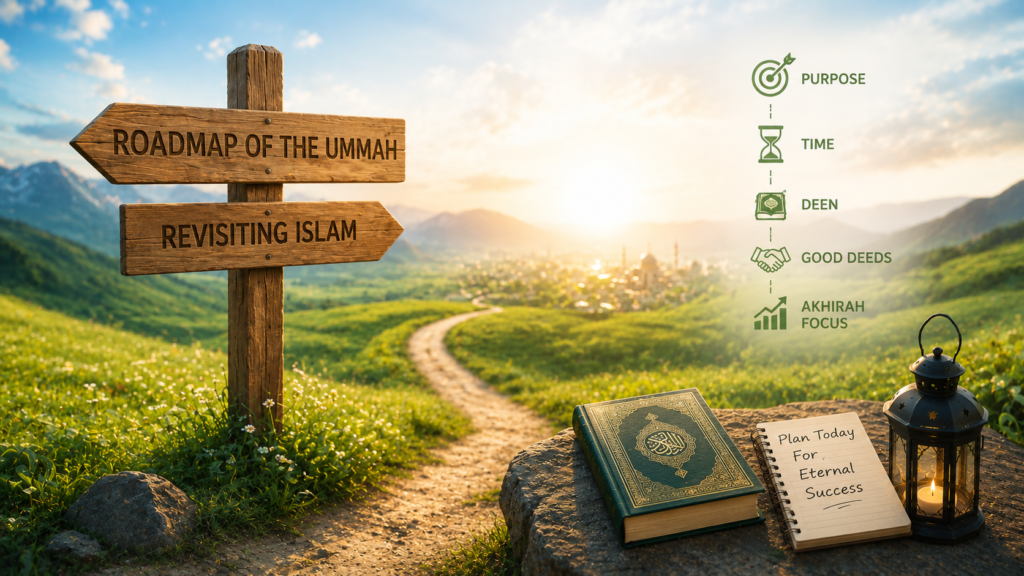
Summary The article, “Roadmap of the Ummah: Revisiting Islam,” urges Muslim youth to move from passive frustration regarding the state of the Ummah to constructive action by adopting the “Makkan model” of social change. It asserts that true submission requires an ideological, psychological, and behavioral shift that prioritizes introspection, moral purification (purging evil thoughts), and […]
Ishq | Muhabbat | Shehwat: The Islamic Rationalization of Love
Summary The article critiques shallow media and poetic narratives of love, arguing that they often screw up the concept’s true essence. It defines a spectrum between “Ishq” (blameworthy passionate intoxication leading to Shirk and loss of individuality) and “Shehwat” (ephemeral baser instinct), locating “Muhabbat” as the proper Islamic middle path. The author asserts that true […]
The Collapse of Belonging: How Injustice Strikes at the Heart of the Ummah

Summary The article asserts that the fundamental sense of home and belonging, valued in Islamic teachings and protected by the Indian Constitution, is being systematically dismantled for Muslims in India through calculated mass demolitions. The author argues that authorities deliberately manipulate and weaponize the law, particularly Part III, as a tool of subjugation rather than […]
Raising Questions: A Shield for Thought, A Sword for Truth
Summary The article asserts that the ability to raise questions is a fundamental, divinely sanctioned human trait, deeply embedded in the Quran and the Sunnah, designed to challenge ignorance and uphold Haqq (Truth and Justice). The author argues that contemporary Muslim youth must embrace eloquent questioning not as a passive exercise, but as a critical […]

 by Md Abullais