
 Submit Work

Introduction
What is ‘love’? Is it the instinctual attraction towards an individual? Is it the obsession to be with someone? Is it the ‘end’/goal of one’s life? Does it express itself in the form of that imaginative bubble produced as a result of overthinking? Is it that subtle tone of violin emanating from a person’s heart upon eye contact? Or is ‘love’ something that traverses beyond the shallow narratives birthed by the media? Unfortunately, poetry has done much harm to the understanding of ‘love’ as a concept. Indeed, poetic expression beautifully captures an individual’s feelings but many a times, it plays a major role in screwing up the essence and objective of love. The author does not intend to criticize poetic expression but the audience must be mature enough to not construe the same as the conceptual understanding of love. The romanticization of Islam through social media has also exacerbated this problem. Yes, congratulations on being created in pairs and completing the other half of your Deen. But the same Islamic symbolism when used out of context, has the potential to impair the Islamic perception of love. In the course of this article, the author will delve into this beautiful concept which can be as fatal as its beauty if not perceived in the right manner.
Ishq and Shehwat: The Two Extremes
Ishq, Muhabbat and Shehwat, though having completely different connotations, are understood interchangeably. In most cases, poetry blurs the line between these words when Arabic words are imported into Urdu. But these words must be understood from an Arabic perspective in order to grasp the essence of their Quranic understanding. Ishq and Shehwat are the two extremes of this spectrum:
- Ishq: The word ‘Ishq’ when translated into English means ‘passionate love’. This kind of love has an intoxicating effect on the person afflicted with such a passionate feeling. Such intoxication deviates a person from being just and rational. This is the reason which forced Imam Ibn Taymiyyah to conclude that it was not proper to love Allah passionately as well. Imam said, “…passionate love is a love exceeding the proper bounds, as for the love of Allah, then it has no end and cannot exceed the proper bounds. Passionate love is to be considered blameworthy without any exceptions, it is not to be praised when it is directed towards the Creator or created because it is a love that exceeds the proper bounds.”[1]
The consequences of Ishq may vary from person to person but they may be summed up in the following points:
- Loss of individuality – Ishq poisons a person with such passion that the person afflicted by it loses his individuality. An Islamic personality is characterized with strong individuality due to the fundamental concept of Tauheed. According to Islam, a man’s source of individuality is only Allah. The Quran unequivocally declares, “And do not be like those who forgot Allah, so He made them forget themselves. It is they who are rebellious.”[2] According to this verse, a man’s true nature and individuality can only be determined when his identity is sourced from the divine and channelled towards the purpose delineated by his Creator. Any deviation from this course would be tantamount to rebellion against one’s own self. Ishq weakens this divine connection and makes one’s individuality dependent on another person. Such people seek validation from people whom they love and, in the process, they lose out on themselves. A song which depicts Heer’s obsession with Ranjha is a good demonstration of the effect of Ishq.
Ranjha Ranjha kardi ve main aape Ranjha hoye
Ranjha Ranjha saddo ni mainu Heer na aakho koye
(I keep chanting Ranjha’s name, I have become Ranjha myself
Call me Ranjha, don’t call me Heer anymore).
The loss of individuality is indeed a great loss as it jeopardizes one’s hereafter. The Quran emphasizes on individual accountability on the day of judgement and how a person will be left all alone to account for what he did: “On the Day a man will flee from his brother, And his mother and his father, And his wife and his children, on that Day each will be occupied with his own business, making him oblivious of all save himself.”[3] Are we ready for this situation? Are we ready to see our loved ones fleeing away from us and leaving us alone? It might sound sad but none can escape the reality of Qiyamah. Therefore, the loss of individuality is not only a loss in the worldly sense but it is a grave sin. Allah created us with an inclination to self-awareness. At the same time, He equated self-awareness with God consciousness.[4] Therefore, diluting one’s own self for a temporary mortal obsession is utter foolishness.
- Shirk – When a person loses his individuality, the next stage eventually leads to the apotheosis of the Ma’shuq. This leads to giving a share of divinity to a frail human being which shakes the very foundation of one’s faith. The prerogative of ultimate obedience that has been singled out for Allah gets compromised. The divine connection breaks and the Ma’shuq ends up being deified. The person’s course of life, Deen and beliefs become that of the Ma’shuq. A good example of the same are interfaith marriages wherein people end up losing their faith and, in many cases, adopting their partners’ faith. It is the passionate love for the Prophet which instigates many people to elevate him from his Prophetic position. It is the passionate love for the Sahaba and the Ahl E Bayt which makes people elevate them to the divine pedestal. Here, Shirk is not being used only in the sense of worship but it also refers to the idolization of a person. Idolization is a subtle form of Shirk as it dictates beliefs, values and lifestyle choices. Therefore, this powerful passion has the potential to disillusion one from the existence and overlordship of Allah.
- Injustice – Ishq makes one emotionally fragile and this emotional fragility significantly impairs a person’s moral sense and the ability to differentiate between right and wrong. Once the command of Allah gets replaced with the command of the Ma’shuq, a person is bound to falter and adopt an unjust course of action. The Quran explicitly states, “And [mention, O Muhammad], when Luqman said to his son while he was instructing him, “O my son, do not associate [anything] with Allah. Indeed, association [with him] is great injustice.”[5] Furthermore, when a person passionately loves another person, he may transgress the limits set by Allah in order to please the Ma’shuq. For example, if a husband passionately loves his wife, he may become indifferent to his parent’s needs and may unjustly favour his wife over his parents and vice versa.
This is the reason why the Quran reminds us that if love becomes disproportionate, it has the tendency to lead one astray: “O you who have believed, indeed, among your wives and your children are enemies to you, so beware of them…”[6] While explaining this verse, Imam Ibn Kathir quoted Mujahid who said, “They might direct the man to sever his relation or disobey his Lord. The man, who loves his wives and children, might obey them in this case.”[7]
The Quran further orders: “O believers! Stand firm for justice as witnesses for Allah even if it is against yourselves, your parents, or close relatives.”[8] Therefore, no relationship, no matter how deep and profound it may be, is allowed to overshadow the dictates of justice. But Ishq forces one to be unjust in many situations and that is why the Quran warns us that we need to dodge these red flags while navigating through any relationship.
- Shehwat: In this context, Shehwat is the prompt of the baser self. The instinctual attraction towards the opposite sex and other desires, whether sexual or not, originate from Shehwat. It is the root cause of that initial infatuation which drives a person towards another. In the hierarchy of love, this is most shallow form of attraction. Its shallowness stems from its lack of depth of the actual meaning of love and its ephemeral nature. The Quran employs the word in the context of the temporariness of worldly desires: “Men are naturally tempted by the lure of women, children, treasures of gold and silver, horses of mark, cattle and plantations. These are the enjoyments in the life of this world; but with Allah lies a goodly abode to return.”[9] Therefore, Shahwat or the desires of this world are temporary and therefore, a true Muslim’s life choices must be reverse engineered from the Akhirah. The attraction is only a ‘means’ to achieve an ‘end’ but in many cases, people perceive these desires as ‘ends’ and end up ruining their Akhirah. It is the disruption of this equation which forces poets and song writers to lexically portray the bosoms and loins of women. If it were not for artistic freedom, the diluted understanding of obscenity and sometimes, the sophistication of the Urdu language, most of these people would have ended behind bars. Being apprehensive of this very instinctual urge, the Prophet warned, “After me I have not left any trial more severe to men than women.”[10]
The Quran also mentions Shehwat in the context of sexual aberrations: “Indeed, you approach men with desire, instead of women. Rather, you are a transgressing people.”[11] Therefore, Shehwat is just a basic instinct and if a person acts on the basis of Shehwat by masquerading it as love, it is bound to be misattributed. This misattribution of man’s basic desire of belongingness, many a times, leads to misguidance. This was the desire that led Zulekha to seduce Yusuf (A.S.) but as he was God-conscious, he was able to avert her attack.
Love Rationalized
Wherever the Quran mentions ‘love’, it employs the word ‘Hubb’. ‘Hubb’ is the root of the word ‘Muhabbat’. The interesting part is that even while explaining the relationship of man and God, Allah uses this word: “Indeed, Allah loves the doers of good.”[12] The use of ‘Hubb’ for Allah profoundly sums up the concept of love. Indeed, Allah is Al-Adl (The Just) and any word or attribute used in this context leads to the assumption that even if Allah loves, he loves justly. This also means that if someone is unjust, Allah does not love him. It has been mentioned in the Quran: “Surely, Allah does not love the transgressors.”[13] This means that love is not an isolated feeling. Rather, love must be accompanied with the basic purpose of life as delineated by Allah.
This can be proved by the following hadith: “A woman may be married for four things: Her wealth, her lineage, her beauty or for her religion. Choose the religious, may your hands be rubbed with dust (i.e., may you prosper).”[14] Therefore, the basic consideration of love is a rational one and not an emotional one. Faith is the determinant of how a Muslim’s emotions are channelized. If such channelization of emotions is devoid of faith, it will end up in either of the two extremes of Ishq or Shehwat. While explaining the basic etiquette of love, Allama Iqbal said:
“Khamosh Ae Dil! Bhari Mehfil Mein Chillana Nahin Acha,
Adab Pehla Qareena Hai Mohabbat Ke Qareenon Mein”
(Silent, O Heart! Crying in the full assembly is not good
Decorum is the most important etiquette among the ways of Love).
Therefore, love must be regulated and bound by etiquettes and rules. Here, that ‘Adab’ of Muhabbat is to follow the commandments of Allah. Muadh ibn Jabal reported that the Prophet said that Allah, the exalted says: “It becomes incumbent upon Me to bestow My love on those who love one another for My sake, meet one another for My sake, visit one another for My sake and spend money on one another for My sake.”[15] This hadith clarifies that love must be for the sake of Allah and the union of a man and woman through love must strengthen their relationship with Allah. This model of Muhabbat can be understood with the help of the following diagram:
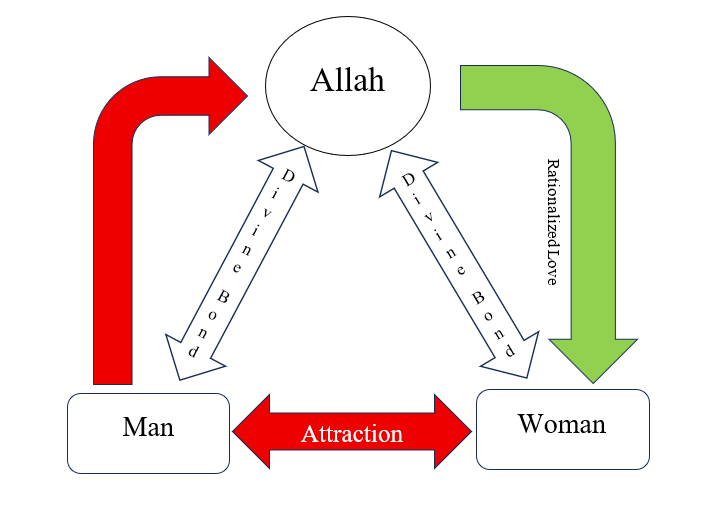
The diagram demonstrates the process of rationalization of love. The red arrows indicate attraction. Once the primary attraction towards a person passes through a man’s divine bond with Allah, the primary attraction, after being synthesized, takes the form of a rationalized love (depicted by the green arrow). The divine bond with Allah plays a role in strengthening the relationship by providing a moral, spiritual and rational compass to the relationship. If the divine bond weakens, there will be no question of etiquettes of love. That primary attraction will take the form of a fire, will provide some heat to the bond, but will end up burning both the parties involved. Therefore, the existence of God-consciousness is what makes a relationship stable and just. It saves people from the Shirk of the Ma’shuq and transient lust. In this equation, Allah is at the top of the hierarchy. This compels people to prioritize Allah’s commandments and establish a relationship that is in consonance with those commandments.
The absence of Allah disrupts the whole equation and problematizes love. When there is no primary divine bond, a person becomes desperate to be connected with someone. Therefore, in the absence of divine love, only worldly love remains. It is this desperation which has been rightly stated in the song ‘Saadgi’:
“Zindagi Ke Safar Mein Bohot Door Tak
Jab Koi Dost Aaya Na Humko Nazar
Humne Ghabra Ke Tanhaaiyon Se Saba
Ek Dushman Ko Khud Humsafar Kar Liya”
(In this lonely worldly journey when I was unable to spot a single friend
Frightened by my loneliness, I took my foe as a life partner).
Even Shakeel Badhayuni once said:
“Veeraani e dil jab had se badhi
Ghabra ke Muhabbat kar baithe”
(When the desolation of the heart crossed all limits,
I, in desperation, fell in love).
These couplets explain the consequences caused by the void of a uniting divine bond in any relationship. Apart from this, Islam does not consider any relationship to be perfect. Love may fade and the relationships may weaken. In such situations, people are prone to transgress the etiquettes of love and the limits set by Allah. Therefore, Islam provides for breaking away from such relationships (divorce) to prioritize the divine bond. This averts unreasonable unpleasantness and unjust behaviour. It was this prioritization of Allah’s commandments that helped Yusuf (A.S.) to save himself from being lured by Zulekha: “She advanced towards him, and he would have done likewise, had he not seen a sign from his Lord. This is how We kept evil and indecency away from him, for he was truly one of Our chosen servants.”[16]
Another thing that must be kept in mind is that the first rule of love is that one should never desire his Mahboob, but rather, one should pray for the betterment of his Mahboob’s destiny.
“Aap apne Mahboob ko na chahein
Balki uske lie khair chahein”
This is the point where love matures and ultimately culminates in the most just expression of one’s feelings. As the author would put it:
“Qurbat jinki bezaar kar jae, Koi humein aise rishton se bachae
Allah aapko duniya ke aur humein aapke fitnon se bachae”
(May I be saved from relationships whose closeness only brings weariness.
May Allah protect you from the trials of this world, and protect me from the trials that come through you).
References
Quran [Al Hashr:19]. ↑
Quran [Abasa:34-37] ↑
Quran [Al Hashr:19]. ↑
Quran [Luqman:13]. ↑
Quran [Taghabun:14]. ↑
Tafsir ibn kathir ↑
Quran [An Nisa:135]. ↑
Quran [Al Imran: 14]. ↑
Sahih Bukhari, Kitab Un Nikah, 5096, Muttafaqun Alayhi. ↑
Quran [Al Araf: 81]. ↑
Quran [Al Baqarah:195]. ↑
Quran [Al Baqarah:190]. ↑
Sunan Ibn Majah, Kitab Un Nikah, 1858. ↑
Musnad Imam Ahmad ↑
Quran [Yusuf:24]. ↑

 by Md Abullais